Showing posts with label 1984. Show all posts

Thursday, June 17, 2010

Orwell in Context


Goldstein's book, you understand. . . . It may be some days before I can get hold of one. There are not many in existance, as you can imagine. The Thought Police hunts them down and destroys them almost as fast as we can produce them. It makes little difference. The book is industructible. If the last copy were gone, we could reproduce it almost word for word.
Orwell, 1984

Accompanying my research in China's digital totalitarianism and 1984, I have been musing over Orwell's place in the mess of it all. While my posts relating to China's Personal Ministry of Truth focus mainly on the affairs of China in the light of Orwell's novel, I spent time considering Orwell's larger role. Can 1984 become a symbolic representation rather than just an obscure point of comparison? I believe it can.

1984 is a futuristic look at the world Orwell feared would soon come to fruition: a totalitarian governing body which denied the rights of speech and thought. Armed with military power, torture chambers, advanced surveillance techniques, and propaganda, and entire body was conquered and manipulated by the force of Big Brother. Beneath the authority, however, in a deep underground, is a resistance and a book to accompany it. Untitled, known only as the book, this records the first days of Big Brother's regime, the world before his advent, and the methods by which he maintains control. Written by the foremost traitor to Big Brother, Emmanuel Goldstein, the book is the most threatening piece of truth attacking the Party's rule; naturally, it is forbidden and it is destroyed immediately once discovered.

As I reviewed the role of Goldstein's book, I could not help but connect it to Orwell himself. 1984 is banned in China; it questions government authority and exposes the dank recesses of totalitarianism. 1984 reveals the methods by which governing bodies manipulate power, brainwash its citizens, fabricate truth and history, censor the media, and condemn those who would dare think or theorize. 1984 exposes it all, and China cannot have that.

Monday, June 14, 2010

IGNORANCE IS STRENGTH


Who controls the past controls the future, who controls the present controls the past.
George Orwell, 1984. Slogan of the Party.

I have been researching the Chinese government's use of technology. In earlier posts, specifically China's Personal Ministry of Truth, I have examined the government's Internet censorship protocol as well as other restrictions placed to limit the freedoms of the digital world. I have repeatedly turned to the Orwell's novel 1984 to examine the sympathies binding China's restricting policies to the dark future dominated by Orwell's Big Brother and the Thought Police. Thoughtcrime on the Internet concentrates on China's efforts to ban unsatisfactory ideas while counteracting those who would threaten complaint in the public sector; the focus thus far has been methods to keep the bad out. China, however, is clever enough to recognize an exploitable tool when it sees one. The Internet, as used by the Chinese government, it not simply an ambiguous world in need of censorship; it is a tool which writes history and dictates the present.

The Cultural Revolution and Little Red Book
China is no novice in the art of propaganda. In fact, one may say they wrote the book on it. In 1966 Mao Zedong was the chairman of Communist party in China. Disgusted with old ideologies and believing the past to be corrupting the possibilities for a purely Marxist future, Mao's regime authorized the Cultural Revolution spanning from 1966 until, arguably, Mao's death in 1976. this revolution was a radically destructive era. This revolution annihilated China's religious, dynastic, and historical legacy; with disregard and disinterest, Mao encouraged the systematic destruction of monasteries, literature, landmarks, temples--anything which might recall old thoughts or old ideals. Slaughtering thousands in the process and driving more to humiliation and suicide, Mao's regime smothered the people in the present ideologies and removed all traces of the past.

Having eliminated all unsatisfactory influences from the presence of his people, Mao set his sights to the molding of their psyche. As mentioned in The Past. The Future? Mao also instigated the Little Red Book, a small compilation of the teachings and ideologies of Chairman Mao. As unwritten law, citizens were obliged to carry the book at all times, turning to its pages throughout the day to dominate their minds with the words of their leader. The Little Red Book allowed Mao the power he sought: he controlled the past by elimination, the present by indoctrination. What worries could there be for the future?

New advancements on the technological front have done little to sway China from their propaganda prominence. While Mao effectively controlled China's mindset through the printed medium, the Communist government is applying new tools to old tricks as they continue to manipulate the minds of the masses through their use of technological propaganda.

A Government-Infused Medium

Who controls the past controls the future, who controls the present controls the past.

China still maintains a firm grip on the past. Massacres such as that at Tiananmen Square never occurred, as testified by historical documents and Internet sources. The effort to ban such topics, arguably, fall within the realm of censorship. Beyond these efforts, however, rests a more active effort to distort the public understanding, reaction, and opinion of current events and governmental measures. The Chinese government employs others to puppet the minds of citizens online, swaying opinion towards government favor. From the New York Times, the article China's Censors Tackle and Trip Over the Internet attacks directly the government's efforts to brainwash the masses via government proxy:

Another strategy is manipulation. In recent years, local and provincial officials have hired armies of low-paid commentators to monitor blogs and chat rooms for sensitive issues, then spin online comment in the government’s favor.

Mr. Xiao of Berkeley cites one example: Jiaozuo, a city southwest of Beijing, deployed 35 Internet commentators and 120 police officers to defuse online attacks on the local police after a traffic dispute. By flooding chat rooms with pro-police comments, the team turned the tone of online comment from negative to positive in just 20 minutes.


According to one official newspaper editor who refused to be named, propaganda authorities now calculate that confronted with a public controversy, local officials have a window of about two hours to block information and flood the Web with their own line before the reaction of citizens is beyond control.

China is willing to don as many masks as necessary, it seems, to maintain the control and power it enjoys. Taking lessons from Mao himself, technology has only aided the Communist party as it employs savvy methods to disrupt the memory of the past as well as the present. It seems, again, as if Orwell was right on mark. One of the foremost slogans of the Party, the governing power in Orwell's futuristic London, is the phrase IGNORANCE IS STRENGTH. There is great power for the ruler of the ignorant. By maintaining ignorance to the past, ignorance to the true present, ignorance to identity, ignorance to potential, maintaining IGNORANCE itself, the threat for rebellion almost disappears entirely.
Thursday, June 10, 2010

A Response from the Expert and Thoughts on the Telescreen

Continuing with my study of the use of new media in China, I recently received an e-mail from an expert of on the subject. I have been looking specifically at Orwell's text 1984, and analysing whether technological advancements, such as the Internet and digital forms of communication, push the Chinese government towards the totalitarian world of Big Brother, or if these advancements prevent such a transformation from ever occurring. As I mentioned in my earlier post Questions for the Expert, I sent an e-mail to John Tkacik Jr. whose article "China's Orwellian Internet" has already been influential to my research. This afternoon, he was kind enough to respond:

Allison --- The emergence of IPv6 (Internet Protocol version 6) as the standard internet language for China will make it far easier for the state to identify specific IP addresses on specific machines – making it far easier to identify the precise machine that any communication comes from, and far simpler to cache all messages to/from that machine. So, I’m afraid China’s internet is now less of an instrument of free expression and more of an instrument of state repression . . . but it can be used by the regime to induce State-approved thinking. . .

You may also be interested in “Trojan Dragon” which Heritage published in early 2008. . .

John


I was very grateful for the time he took to respond, and more so for the suggestions he offered. I spent a little time looking into IPv6, and while comprehension of the cogs which run the Internet-machine are not my speciality, Mr. Tkacik's brief summary of its larger uses help illustrate the danger. The Chinese government, it seems, is finding increasing power with every technological advancement, and not vice versa.

While the Chinese government has already proven its ability to track and find cyber-dissidents, this particular advancement will make the process quicker and more efficient. Which leaves more time for the judicial process to take over.

At the risk of changing the subject entirely, Mr. Tkacik's e-mail has started my mind in an interesting direction. In 1984, the governing body, INGSOC, is a glutton for surveillance. In every pubic arena, facility, bar, institution, and home is found a telescreen, a device which is part television, part security camera. The telescreen is always on; only the most elite members of the government Party have the power to turn it off. All day it emits news, reports, ration alerts, war updates--anything to spew Big Brother's propaganda. As it sends propaganda out, the telescreen also takes a great deal in: anything within sight and hearing is recorded and may be scrutinized--at any time--by the Thought Police. Perhaps the phrase BIG BROTHER IS WATCHING YOU is familiar. Well, as Orwell writes, he is watching. Though the telescreens he sees everything.


Returning again to China, their implementation of IPv6 is a more refined process of linking online identities to physical persons. The distance between the government and the individual is becoming thinner and thinner as technology develops. How much longer before the Chinese government--or any organization--can work the same magic as Big Brother's telescreen? With webcams and microphones automatically built into most computers, how big of a jump is it to recreate Orwell's methods of surveillance?

I'm starting to think more and more that Big Brother's telescreen was not an immediate process. I have a difficult time imagining technology of this caliber appearing overnight in the homes of the masses. Perhaps it was merely the slow transformation of technological tools already in wide use. We've come to rely so heavily on our media; televisions, computers, scattered throughout every home. The technology is already in place, it seems. There only waits for a government to utilize the tools already available. Orwell wrote the book on totalitarian surveillance, and it appears China is reading it.

Wednesday, June 9, 2010

Physically Returning to Orwell, Digitally

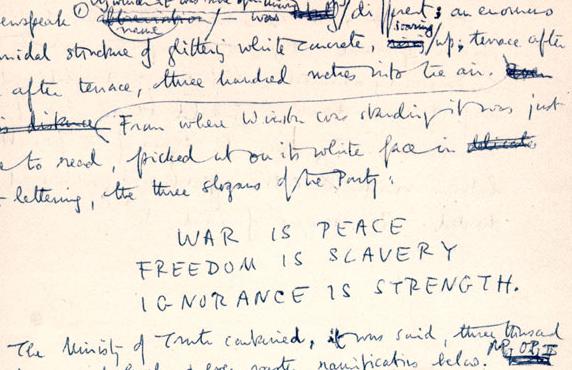
Following the suggestions of my professor Dr. Burton, I am returning to the basis of my research in China: George Orwell's text 1984. This return, however, is not the traditional sense of grabbing my personal addition and again scour the pages for appropriate quotes and references. Instead, this return is to examine the process of Orwell himself, to explore the text beyond the publicized page. Using the advancements technology has supplied, I have returned the the text as Orwell worked it: his manuscripts.


A very primal draft. One thing I find particularly interesting is Orwell's meticulous use of capped letters. In the official publication of 1984, the slogans of the party here represented--WAR IS PEACE, FREEDOM IS SLAVERY, IGNORANCE IS STRENGTH--are capitalized, expressing deserved volume. The manuscript shows that Orwell intended this detail from the beginning. He meant for the slogans to scream.


This version is more formalized than the previous manuscript, or was, I suppose, before Orwell painted it with his pen; it is the first page of the first official draft. I had never appreciated the process Orwell undertook to collect his thoughts and ultimately finalize them to produce the finished novel. This page has been absolutely torn apart; Orwell took very seriously the thoughts he transmitted to paper.

As I look at this draft in particular, I really am amazed at the process Orwell drafted, deleted, reworded, restructured, and revamped what is arguably his most poignant novel. To bring in a touch of the biographical, Orwell was suffering from the debilitating effects of tuberculosis. The years he formed 1984 were particularly difficult as he constantly battle the disease he knew was killing him. I find myself with little to say, simply overwhelmed, in a sense, to appreciate the efforts of a dying man, meticulously forming his last words.

Thursday, June 3, 2010

China's Personal Ministry of Truth

A Touch of Background
A few months ago, I was an avid reader of the New York Times; I had just returned to the United States after a substantial stint in Taiwan, and found myself engrossed with any news at all pertaining to Asia. My fascination was chiefly concerned with the happenings of Taiwan and China, and my dedication to the New York Times regularly rewarded me with plenty of reading material.

At the time, China was a hot topic of both conversation and controversy as its rocky relationship with the global company Google started attracting attention. Unwanted notice followed as journalists highlighted the government’s thorough system of Internet filtering, a process government leaders deny with the repetition characteristic of broken records. As I read headlines and articles, I could not help but find an eerie-sort of familiarity resonating between the Chinese government and the dark totalitarian world depicted by George Orwell in his epic novel, 1984.

The Comparison Explored


I do not pretend this is a novel comparison; I am not the first and most certainly will not be the last individual to see the red giant as a shadow of Orwell’s dark utopia, but I could not help but see the parallel images created by China’s numerous propaganda departments and 1984’s Ministry of Truth. The Ministry of Truth is one of four governing ministries which promulgate the power of a totalitarian government. While other ministries concern themselves with war, famine, and torture, the Ministry of Truth is concerned with information-control. Utilizing, ironically, a complex system of fabrication and deceit, the Ministry of Truth is able to manufacture truth.

Using rudimentary tools applicable to Orwell’s mid-twentieth century understanding of technology, 1984's government employees, known as Party members, alter, destroy, distort, and otherwise fabricate any part or portion of media deemed unsatisfactory by the leaders of the nation. The range of influence is baffling; This process of continuous alteration was applied not only to newspapers, but to books, periodicals, pamphlets, posters, leaflets, films, sound tracks, cartoons, photographs—to every kind of literature or documentations which might conceivably hold any political or ideological significance. All this is accomplished without the scope of technology now taunting governments of similar sentiments.

Legitimate Fears?
My thoughts as I scanned the series of newspaper articles frequently returned to a dominant vein of questions: will our contemporary technological advancements permit the creation of the totalitarian super-body envisioned by George Orwell? Will technology, with its intricate system of loopholes and bypassed firewalls allow for a rebellion considered impossible in Orwell’s world? Or, conversely, does technology prove totalitarianism’s best friend, creating a government force capable of omniscience surpassing that feared by Orwell himself? What role does technology have in dictating power distribution? With a nation saturated with the advancements of technology, is China’s totalitarian transformation an impossibility or inevitability?

These themes deserve a more calculated look. The following posts will discuss these questions in greater detail:

Thoughtcrime on the Internet
IGNORANCE IS STRENGTH
The Summation of Thought

Friday, May 28, 2010

Wordle.net. The New Toy.


The entire text of 1984. Sadly, it does no justice.

Thursday, May 27, 2010

Naivety Gone, Thank You Orwell

Thus far, this blog has served as an expansive space to explore, in a sense, my research and own thoughtful musings. I have been researching the role Internet and new media play in the lives of the Chinese people and in their powerhouse government. More specifically, I have been examining new media from the perspective of the spectrum's counterpoints: an avenue for rebellion among the underground (emerging?) human rights activists or a seemingly invincible government weapon capable of annihilating any hope for revolution.

I can honestly say I approached the research process with as little bias as possible. I had never really studied the freedoms either opened or barricaded by the contrastive uses of media. I tried to understand the activities on both sides of the spectrum as well their respective repercussions. I am sorry to say, however, that in true Orwellian style, the government remains the victor.

True, there are plenty of counterarguments regarding Chinese activists rallying anti-government sentiment, however, the countless instances of government intervention, notable abductions and disappearances, and the point-blank removal of Internet services entirely only prove that the government's power is safe. Safe and sound and is likely to remain so.


If you have never read George Orwell's 1984, you may want to stop reading now.


In an oddly transcendent sort of way, realizing the seemingly impenetrable power China holds with its mouse and keyboard took me back to the night I finished Orwell's 1984 for the first time. It was some years ago, but I can still remember my hopeful naivety as I struggled through the last chapter. I still, in a way, hoped for redemption, but with every paragraph, every sentence, realized it would not come. I believe I even cried a little when I finally put the book down and accepted Orwell's future hell. Focusing on China, now, and finding myself nose to nose with a manifestation of Orwell's prediction is quite an unsettling experience, to say the least.

I wanted to be wrong; I wanted Orwell to be wrong. I wanted technology, new media, these creations unpredicted and unforeseen by Orwell, to somehow defy any government's efforts to establish totalitarianism. However, I have to return to Orwell again, I have to admit defeat again and resign my naivety yet again. China is as Orwell predicted; new media, Internet, technological advances have served Big Brother well.